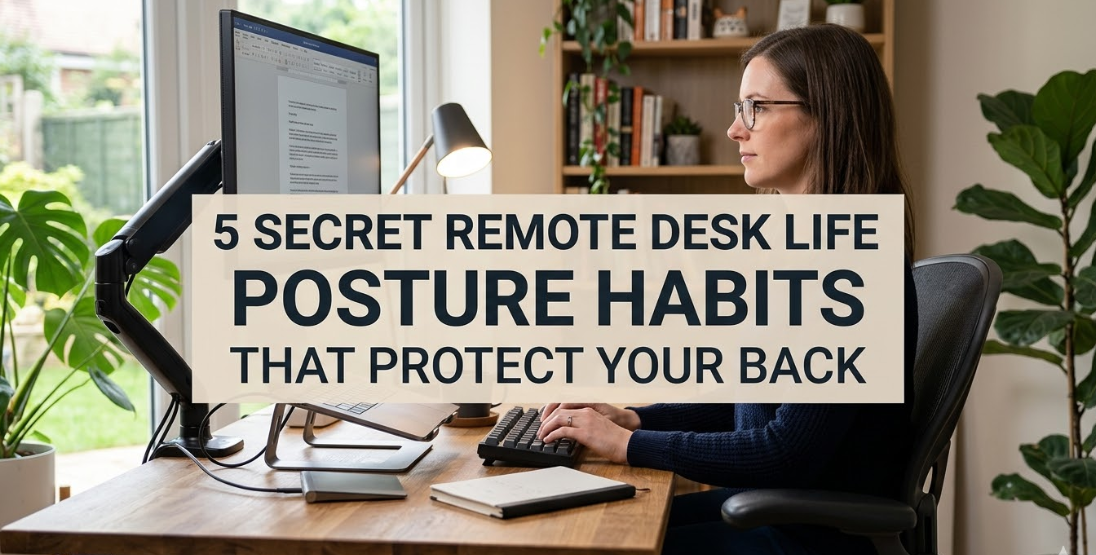
Five Secret Posture Habits for Remote Desk Life That Could Save Your Back
If you work at home, your back already knows the story.
It aches by noon. It stiffens after long calls. It tells you every night that something is wrong.
Remote work has granted us freedom — but it has sneakily robbed us of our posture. Most of us are sitting on kitchen chairs, hunched over laptops, or working from a couch for 8+ hours a day. And the damage adds up fast.
But here is the good news.
You don’t need an expensive ergonomic chair or a fancy standing desk to fix it. What you need are the right habits — small, steady, and strategic. The kind most remote workers never hear about.
This article outlines 5 secret remote desk posture habits that actually safeguard your back. Not the generic “sit up straight” advice. Tangible habits that make an actual difference.
Let’s get into it.
Why Remote Work Is Stealthily Wrecking Your Spine
Before the habits, you have to know why this is happening.
You move more when you work in an office. You walk to meeting rooms. You get coffee down the hall. You squirm and shuffle all day long.
At home? You barely move at all.
Studies indicate remote workers sit an average of 1–2 hours more than office workers each day. That added sitting compresses the lumbar discs in your lower back, deconditions your core muscles, and shortens your hip flexors — all at once.
Your body wasn’t designed to stay immobile for that many hours.
The outcome is a slow, creeping pattern of pain. First it is mild discomfort. Then it becomes tension. Then it manifests as chronic lower back pain, neck stiffness, or even nerve problems like sciatica.
The scary part? Few people recognise how posture may be a primary cause of their aches — until the damage has already been done.
This is precisely why the habits listed below are so important.
Habit 1: The 90-90-90 Reset — How Your Body Gets Into Daily Alignment
Most posture advice will tell you to sit up straight. But that advice misses the how.
The 90-90-90 rule is one of the most underrated yet powerful posture resets in remote desk life. It means that when you sit, your body should form three 90-degree angles:
- Hips at 90° — thighs parallel to the floor
- Knees at 90° — feet flat on the ground
- Elbows at 90° — forearms parallel to the desk
This alignment isn’t just about looking right. It distributes your body weight evenly through your spine, pelvis, and legs. As soon as one angle goes off — knees too high or elbows reaching up, for instance — the entire chain of your spinal mechanics is disrupted.
How to Do the 90-90-90 Reset Each Morning
Start every workday with this 60-second check:
- Sit in your desk chair and adjust its height so your feet rest flat on the ground.
- Make sure your thighs are level — neither lifted nor sagging.
- Rest your forearms on the edge of your desk so your elbows bend naturally at 90°.
- If your monitor sits too low, prop it up with books or a stand until your eyes align with the top third of the screen.
Run through this reset every morning before you start work. Under a minute — and beneficial for your spine all day long.
Common Mistake to Avoid
Most remote workers skip this because their setup “feels fine.” But feeling fine isn’t the same as being aligned. Misalignment is typically painless — until it isn’t.
| Angle | Target | What Can Go Wrong Without It |
|---|---|---|
| Hips | 90° | Pelvic tilt puts strain on lower back |
| Knees | 90° | Compression in the legs limits circulation |
| Elbows | 90° | Tension builds up in shoulders and neck |
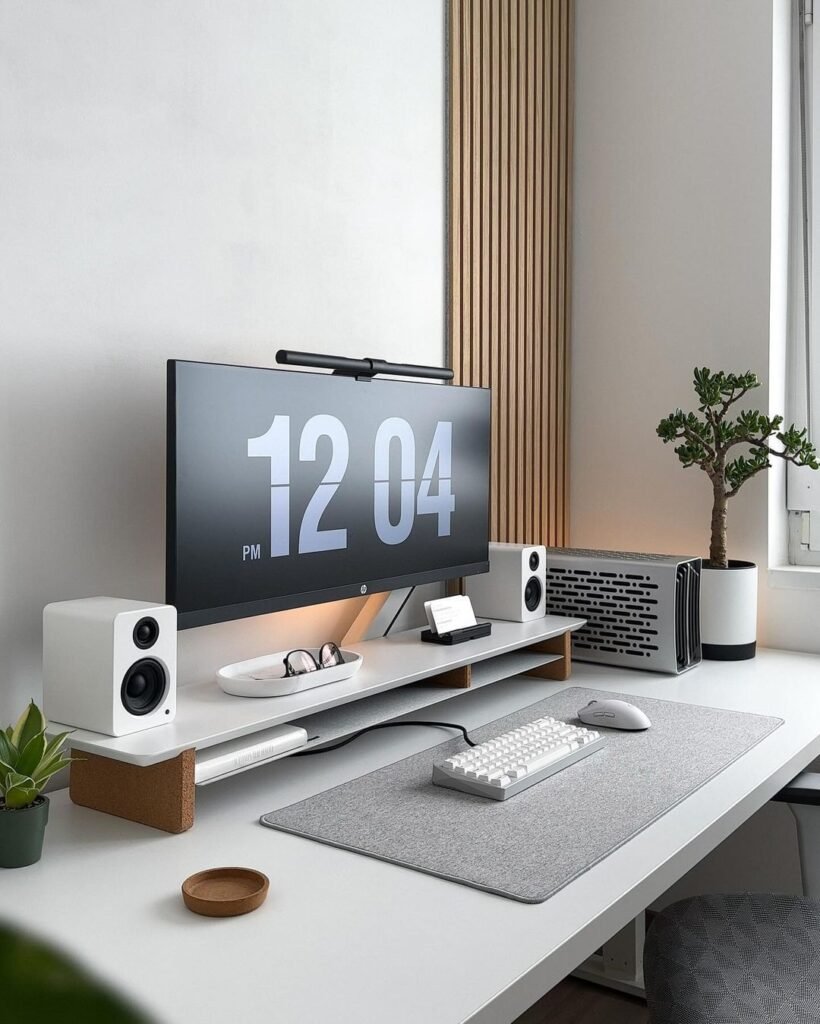
Habit 2: Micro-Movement Stacking — Move Without Leaving Your Desk
This is a habit that almost nobody talks about.
It’s not about taking breaks. It’s about embedding small, purposeful movements into your sitting time so that none of your muscles ever completely switch off.
If you sit completely still for hours, your spinal muscles enter a passive phase where they are no longer actively supporting your spine. This is when posture collapses — shoulders rounding, chin jutting forward, lower back flattening.
Micro-movements prevent this from happening.
What Micro-Movement Stacking Looks Like
Weave these small actions into your workday without breaking focus.
Every 20–30 minutes, do one of these:
- Seated pelvic tilt — rock your pelvis forward and backward 10 times. This reactivates your lumbar muscles.
- Shoulder blade squeeze — draw your shoulder blades together and hold for 5 seconds. Repeat 5 times.
- Neck half-circle — drop your chin to your chest, roll it slowly to one side, then back to centre. Never roll fully backward.
- Foot pump — keeping heels on the floor, lift your toes, then reverse. This keeps blood circulating in your legs.
None of these require you to get up. None take longer than 30 seconds. But together they keep your spinal muscles engaged and counteract the “frozen posture” slump that leads to pain.
The Stacking Part
The word “stacking” is key. Connect these small movements to things you already do:
- After you tick off a task → shoulder blade squeeze
- Before every call → seated pelvic tilt
- Whenever you send an email → foot pump
Anchoring movement to existing habits makes it automatic. You don’t have to think about it.
Habit 3: The Screen Distance Rule Most People Get Wrong
Most people guess wrong when asked how far their screen should be.
The most common answer is “arm’s length.” That’s close — but the real rule is more specific, and more important.
Your screen should be far enough away that you can read the text clearly without leaning forward even slightly. That is the key test. Not a measurement. A lean test.
Here’s why this matters so much for your back.
The Forward Head Domino Effect
When your screen is too close or too low, your head naturally tilts forward to see it. For every inch your head moves forward out of neutral position, the effective weight on your neck and upper spine increases dramatically.
A head that typically weighs 10–12 pounds can place up to 60 pounds of pressure on your cervical spine when tilted forward at a 60-degree angle. That force travels down into your shoulders, between your shoulder blades, and into your lower back.
This is known as forward head posture, and it is one of the most common causes of chronic back and neck pain among remote workers.
How to Fix Your Screen Distance Now
- Pull your monitor back until it’s about 20–28 inches from your eyes.
- Adjust the screen so its top edge is at or just below eye level.
- Recline slightly in your chair — 100–110 degrees rather than fully upright. A slight recline actually reduces spinal disc pressure.
This is especially important if you use a laptop. Laptop screens are almost always too low. Use a laptop stand to raise it to eye level, paired with an external keyboard.
Screen Position Quick-Check Table
| Element | Correct Position | Warning Sign |
|---|---|---|
| Screen height | Top of screen at eye level | You tilt your chin up or down |
| Screen distance | 20–28 inches from eyes | You squint or lean forward |
| Monitor tilt | Slight backward tilt (10–20°) | Glare causes you to shift position |
| Laptop use | Always elevated with stand | Using flat on desk for hours |
Habit 4: The Thoracic Wake-Up Stretch to Do Before Lunch
Most people stretch their lower back. Almost nobody stretches the thoracic spine — the middle section of your back between your shoulder blades.
This is a significant mistake for remote workers.
The thoracic spine is the area most affected by prolonged sitting and screen time. It rounds forward, becomes rigid, and loses mobility. When this happens, the lower back compensates — and that is where the pain shows up.
This means many people who experience lower back pain actually have a stiff thoracic spine. They stretch the wrong area and wonder why nothing improves.
The Thoracic Wake-Up: Step-by-Step
This takes about 3 minutes. Do it before lunch every workday.
Step 1 — Seated Thoracic Extension
- Sit at the edge of your chair
- Clasp your hands behind your head
- Gently arch backward, opening your chest toward the ceiling
- Hold for 5 seconds — repeat 5 times
Step 2 — Thread the Needle
- Start on all fours on a yoga mat or the floor
- Slide your right arm along the floor underneath your left arm, rotating through your upper back
- Hold for 10 seconds — switch sides
- Repeat twice on each side
Step 3 — Doorframe Chest Opener
- Place both forearms against either side of a doorframe
- Lean forward slowly until you feel a stretch across the front of your chest and shoulders
- Hold for 20 seconds
- This directly counters the rounded-shoulder position from hours of typing
Why “Before Lunch” Specifically?
Timing matters. By midday, your thoracic spine has likely been rounded for 3–4 hours. Doing this stretch before lunch breaks that cycle and creates a mid-point reset — preventing the afternoon slump that causes most people to start slouching by 3 PM.
If there’s only one stretch you take away from this article, make it this one.
Habit 5: The Nighttime Spinal Decompression Protocol
This final habit is the most underrated of them all.
During the day, gravity compresses your spinal discs. Every hour of sitting places cumulative strain on these structures. By the end of an 8-hour workday, your spine is literally shorter than it was in the morning. That’s normal — but without decompression, that compression accumulates day after day.
The 5-Minute Evening Decompression Sequence
Complete this routine the moment you finish working — before dinner, before scrolling, before anything else.
Move 1 — Supine Knee Hug (1 minute) Lie on your back with knees bent. Draw both knees into your chest. Rock gently side to side. This releases the lumbar muscles and creates mild traction at the lower back.
Move 2 — Legs Up the Wall (2 minutes) Lie on your back near a wall. Swing your legs up so they rest at 90° against the wall. Close your eyes and breathe slowly. This reverses compression in your low back and helps drain blood that has pooled from prolonged sitting.
Move 3 — Child’s Pose with Side Reach (1 minute) Kneel and sit back toward your heels. Extend both arms forward on the floor. Walk your arms to the right for 15 seconds, then to the left. This stretches the lateral thoracic muscles and the quadratus lumborum — a deep muscle that frequently causes lower back aching.
Move 4 — Seated Forward Fold (1 minute) Sit on the floor with legs extended. Hinge at your hips and lean toward your feet. Don’t force it — let gravity do the work. Breathe into the stretch. This decompresses your entire posterior chain from neck to heels.
The Compound Effect of This Habit
One night of decompression won’t transform your back. But 30 consecutive evenings? That is an entirely different story.
This routine breaks the daily cycle of compression. It improves disc health over the long term, reduces morning stiffness, and builds resilience in the muscles that support your spine.
Remote desk life is not a sprint. Your spine needs its own recovery plan.
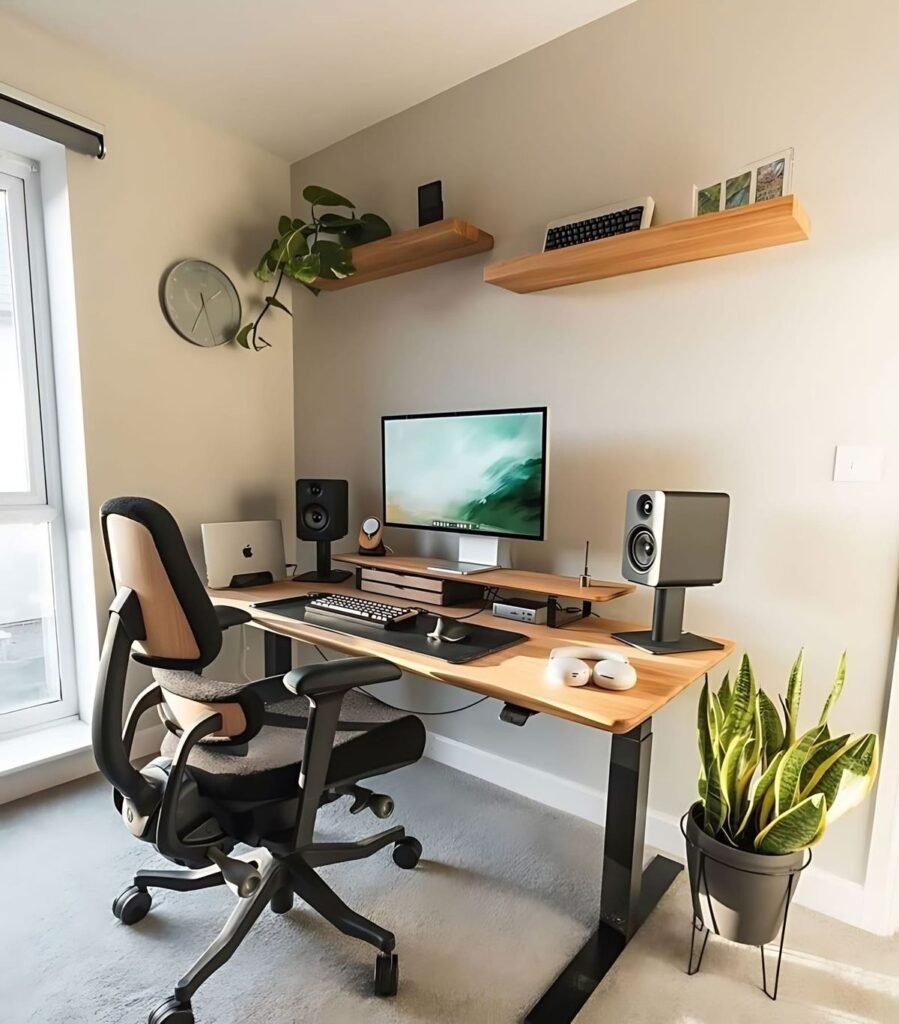
How These 5 Habits Work Together as a System
Each of these habits is powerful on its own. But they are designed to work as a system.
Think of it this way:
- Habit 1 (90-90-90 Reset) → Prepares your body for success at the start of the day
- Habit 2 (Micro-Movement Stacking) → Keeps muscles active throughout the day
- Habit 3 (Screen Distance Rule) → Minimises forward head posture
- Habit 4 (Thoracic Wake-Up) → Resets your mid-back at the midpoint of the day
- Habit 5 (Evening Decompression) → Resets and decompresses your spine after the day
Together, they cover morning, midday, and evening. They address every segment of your remote work day.
For more resources on building a healthier, more ergonomic remote workspace, visit Remote Desk Life — a dedicated hub for people who take their home office setup seriously.
Daily Remote Desk Posture Habit Routine
| Time of Day | Habit | Time Needed |
|---|---|---|
| Morning (before starting work) | 90-90-90 Alignment Reset | 1 minute |
| Every 20–30 minutes | Micro-Movement Stacking | 30 seconds |
| All day | Screen Distance Rule | Ongoing |
| Before lunch | Thoracic Wake-Up Stretch | 3 minutes |
| After work (evening) | Spinal Decompression Routine | 5 minutes |
How to Make These Habits Stick
Understanding the habits is only half the battle. The other half is making them stick.
Here are some practical ways to weave them into your day:
- Use a timer. Set an alarm every 25–30 minutes as your micro-movement reminder. A basic phone timer does the job.
- Post a visual reminder. Write the 90-90-90 rule on a sticky note and place it on your monitor. Visual cues beat memory almost every time.
- Anchor the evening routine to a cue. The moment you close your laptop, get on the floor. Don’t sit on the couch first — you won’t get back up.
- Track your streak. Use a habit-tracking app or a paper calendar. Checking off days builds momentum, and missing one creates just enough discomfort to keep you going.
Common Questions About Remote Desk Posture Habits
Q: How soon will I see results from improved posture habits? Most people notice a reduction in tension and stiffness within 2–3 weeks of regular practice. Deeper patterns of pain can take 6–8 weeks to significantly improve. Consistency matters more than speed.
Q: Can I still do these habits if I already have back pain? Yes — but with caution. The micro-movement routine and decompression sequence are safe for most people with mild to moderate back pain. If you have a diagnosed disc issue, neuropathy, or a recent injury, consult a physiotherapist before starting any new movement practice.
Q: I work from a laptop and can’t raise my screen. What do I do? A laptop stand is one of the best investments a remote worker can make. They cost around $15–20 and solve the screen height problem immediately. Pair it with a wireless keyboard and your setup improves significantly.
Q: Is a standing desk the solution to all of this? Standing desks help, but there are no magic fixes. Poor posture while standing creates its own set of problems — mostly foot, knee, and hip strain. These habits apply whether you sit, stand, or alternate between both.
Q: How often should I do the thoracic wake-up stretch? At minimum, once a day before lunch. If you work long hours or notice tightness between your shoulder blades in the afternoon, do it twice — at midday and again after work.
Q: I always get back pain in the afternoon. Which habit should I prioritise first? Start with the 90-90-90 Reset, followed by the Thoracic Wake-Up stretch. Poor sitting alignment combined with thoracic stiffness is the most common cause of afternoon lower back pain in remote workers. Addressing both often eliminates the problem entirely.
The Bottom Line — Your Back Deserves More Than a Couch and a Laptop
Remote work is not going anywhere. And the longer we work from home without paying attention to posture, the more nature takes its course — with pain, stiffness, and long-term spinal wear.
But none of this needs to be complicated.
Five habits. A few minutes each. Spread throughout your day.
That’s all it takes to change how your back feels — and protect it for years to come.
Start with one habit today. Maybe it’s the morning 90-90-90 reset. Maybe it’s the evening decompression routine. Choose the one that speaks most to your pain and build from there.
Your future self — the one who sits down at 9 AM and stands up at 5 PM without wincing — will thank you.