
6 Proven Remote Desk Life Focus Habits I Wish I Knew Earlier
Remote work sounded like a dream when I first started. No commute, flexible hours, and the comfort of working from home felt like the perfect setup. But after a few weeks, I realized something surprising: staying focused at home is much harder than it seems.
Distractions creep in quietly — phone notifications, household chores, endless emails, and even the temptation to scroll social media “for just a minute.”
The result?
Hours pass, but productivity barely moves.
Over time, I experimented with dozens of productivity techniques. Some failed, some helped temporarily, but a few habits completely changed how I work.
These six proven remote desk life focus habits helped me regain control over my attention, finish work faster, and reduce mental fatigue.
If you’re struggling with focus while working remotely, these habits can transform your workday.
Why Focus Is Harder in Remote Desk Life
Working remotely introduces a few unique challenges:
| Remote Work Challenge | Impact on Productivity |
|---|---|
| Lack of structured office environment | Lower discipline |
| Household distractions | Frequent interruptions |
| Digital overload (Slack, email, apps) | Attention fragmentation |
| Flexible schedules | Procrastination |
| Loneliness or lack of accountability | Reduced motivation |
Research consistently shows that attention switching reduces productivity by up to 40% because the brain must constantly refocus.
That’s why building strong focus habits matters more in remote work than in traditional offices.
Habit 1: Start Every Workday With a “Focus Launch Ritual”
One of the biggest mistakes remote workers make is jumping straight into work without preparation.
In an office, the commute naturally prepares your brain for work mode. At home, that mental transition disappears.
A focus launch ritual replaces that transition.
What a Focus Ritual Looks Like
Your ritual doesn’t need to be complicated. The goal is to signal to your brain that work is starting.
Example routine:
- Clear desk surface
- Open daily task list
- Review top 3 priorities
- Start first focus session
This entire process takes 5–10 minutes, but the mental effect is powerful.
Example Morning Focus Ritual
| Step | Action | Time |
|---|---|---|
| Desk reset | Remove clutter | 2 minutes |
| Task planning | Choose top 3 tasks | 3 minutes |
| Environment setup | Water, coffee, headphones | 2 minutes |
| Focus start | Begin first deep work session | 25–45 minutes |
Over time, your brain associates the ritual with deep work mode.
Habit 2: Use the “3 Task Rule” Instead of a Massive To-Do List
Early in my remote work journey, I created giant to-do lists.
They looked productive — but they actually killed my focus.
A long list creates cognitive overload.
Instead, I learned to use the 3 Task Rule.
Every day, choose only three high-impact tasks that truly matter.
Why This Works
Your brain performs better when priorities are clear.
Focus Impact of Task List Size
| Task List Size | Focus Level | Completion Rate |
|---|---|---|
| 15+ tasks | Low | 20% |
| 10 tasks | Medium | 40% |
| 5 tasks | Medium-High | 60% |
| 3 tasks | Very High | 85–90% |
The smaller the list, the more energy goes into execution rather than decision making.

Habit 3: Create “Deep Work Time Blocks”
Remote work often becomes a day filled with:
• emails
• Slack messages
• quick tasks
• random interruptions
While these tasks feel productive, they rarely create meaningful progress.
That’s why deep work blocks are essential.
Deep work is uninterrupted time where you focus on cognitively demanding tasks.
Ideal Deep Work Structure
| Time Block | Activity |
|---|---|
| 9:00 – 10:30 | Deep Work Session |
| 10:30 – 10:45 | Break |
| 10:45 – 12:00 | Deep Work Session |
| 1:00 – 2:30 | Deep Work Session |
Each block should last 60–90 minutes.
After that, mental energy naturally drops.
Productivity Chart Example
| Work Style | Output Quality | Stress Level |
|---|---|---|
| Multitasking | Low | High |
| Task switching | Medium | Medium |
| Deep work blocks | High | Low |
Once you adopt deep work scheduling, tasks that used to take 4 hours often finish in 1.5 hours.
Habit 4: Design a Distraction-Proof Desk Environment
Your workspace influences focus more than you think.
Cluttered desks increase mental noise.
A distraction-free desk dramatically improves concentration.
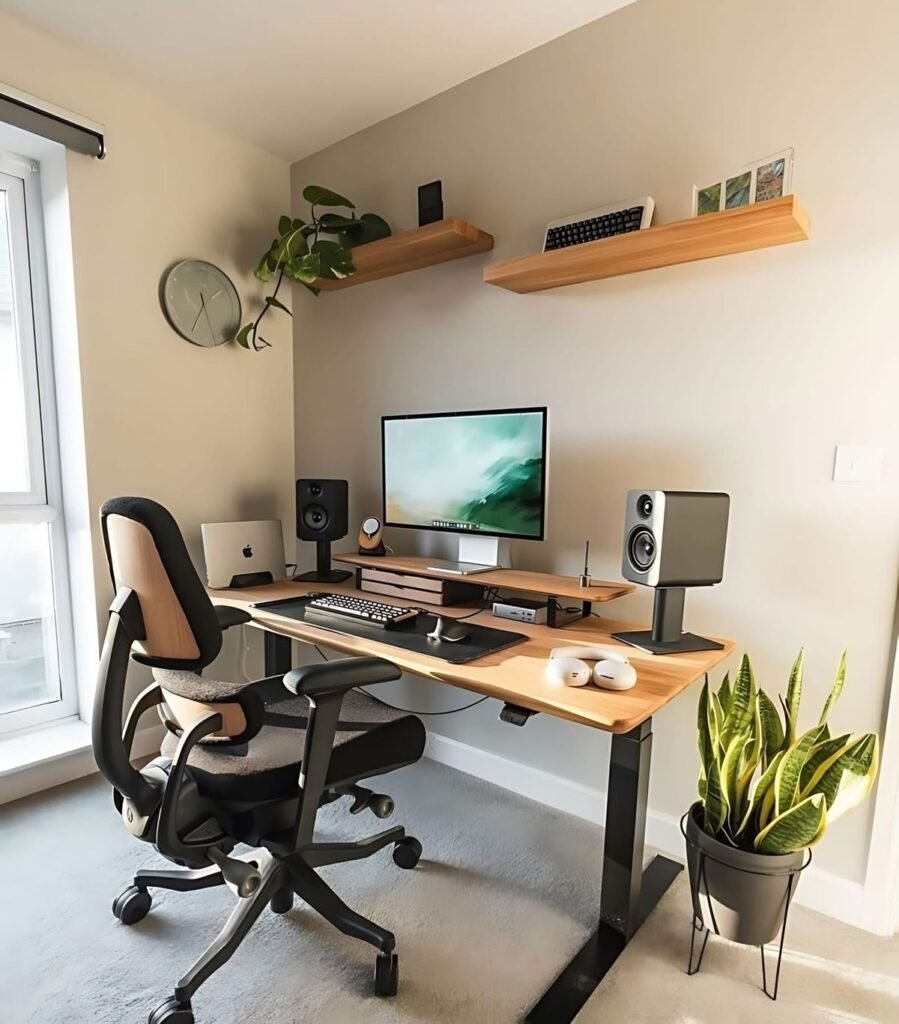
Core Elements of a Focus Desk
| Desk Element | Purpose |
|---|---|
| Minimal items | Reduces visual distraction |
| Proper lighting | Reduces eye fatigue |
| Comfortable chair | Maintains posture |
| Noise control | Protects attention |
Focus Workspace Checklist
| Item | Recommended Setup |
|---|---|
| Monitor height | Eye level |
| Desk clutter | Maximum 5 items |
| Lighting | Natural light or warm desk lamp |
| Noise | Noise-canceling headphones |
Small environmental changes create massive mental clarity.
Habit 5: Follow the “50-10 Focus Cycle”
Most remote workers try to stay focused for hours without breaks.
But neuroscience shows the brain performs best in short cycles of intense work and rest.
One of the most effective patterns is the 50-10 focus cycle.
How It Works
• 50 minutes of focused work
• 10 minutes of break
During the break, step away from the screen.
Stretch, walk, hydrate.
Focus Cycle Example
| Cycle | Work Time | Break |
|---|---|---|
| Cycle 1 | 50 min | 10 min |
| Cycle 2 | 50 min | 10 min |
| Cycle 3 | 50 min | 10 min |
| Cycle 4 | 50 min | 20 min longer rest |
This rhythm prevents burnout while maintaining strong focus.
Habit 6: End Your Workday With a Shutdown Routine
Just like the morning ritual starts focus, a shutdown routine protects mental recovery.
Without a clear ending, remote workers often:
• keep checking messages
• think about unfinished tasks
• feel mentally exhausted
A simple shutdown routine solves this.
Example Workday Shutdown Routine
| Step | Action |
|---|---|
| Review completed tasks | Celebrate progress |
| Move unfinished tasks | Schedule tomorrow |
| Clear desk | Reset environment |
| Close work apps | End work mode |
This routine helps your brain disconnect from work.
Over time, it improves sleep, reduces stress, and increases next-day focus.
Daily Remote Desk Life Focus System
Combining these habits creates a simple daily productivity system.
Example Daily Workflow
| Time | Activity |
|---|---|
| 9:00 | Focus launch ritual |
| 9:10 | Deep work block |
| 10:30 | Break |
| 10:45 | Deep work |
| 12:00 | Lunch |
| 1:00 | Deep work |
| 2:30 | Light tasks |
| 4:30 | Shutdown routine |
This structure protects both productivity and mental health.
Biggest Focus Mistakes Remote Workers Make
Avoid these common traps.
| Mistake | Result |
|---|---|
| Checking email first thing | Distraction spiral |
| Working without priorities | Busy but unproductive |
| Multitasking constantly | Mental fatigue |
| No breaks | Burnout |
| Cluttered workspace | Reduced attention |
Fixing just one of these habits can dramatically improve focus.
Quick Focus Habit Comparison
| Habit | Difficulty | Impact |
|---|---|---|
| Focus ritual | Easy | High |
| 3 task rule | Easy | High |
| Deep work blocks | Medium | Very High |
| Desk environment | Easy | Medium |
| 50-10 cycles | Easy | High |
| Shutdown routine | Easy | Medium |
The best part? None of these require expensive tools or complicated systems.
Just consistency.
Long-Term Benefits of Strong Focus Habits
When remote workers build strong focus routines, they experience:
| Benefit | Result |
|---|---|
| Faster task completion | More free time |
| Less stress | Better work satisfaction |
| Higher quality work | Career growth |
| Better work-life balance | Improved wellbeing |
Focus isn’t about working harder.
It’s about working intentionally.
Final Thoughts
Remote work gives us freedom, but freedom without structure often leads to distraction.
The six habits shared in this guide helped transform my workdays from chaotic and scattered into focused and productive.
To recap:
- Start with a focus launch ritual
- Use the 3 task rule
- Schedule deep work blocks
- Build a distraction-free desk
- Follow the 50-10 focus cycle
- End with a shutdown routine
You don’t need to implement everything at once.
Start with one habit this week, then gradually build the system.
Your focus — and your productivity — will improve dramatically.
Frequently Asked Questions (FAQs)
1. How can I stay focused while working remotely all day?
The best approach is using structured focus habits, such as deep work blocks, short breaks, and clear daily priorities. These techniques help maintain mental energy and prevent distraction.
2. What is the best focus technique for remote workers?
Many remote professionals find the 50-10 focus cycle or 90-minute deep work sessions highly effective because they align with the brain’s natural energy rhythms.
3. How do I avoid distractions while working from home?
Start by optimizing your workspace. Reduce clutter, silence notifications, and use headphones if necessary. Creating a dedicated workspace dramatically reduces interruptions.
4. How many tasks should I plan each day?
Experts recommend focusing on three high-priority tasks per day. This keeps your workload realistic while maximizing productivity.
5. Why is a shutdown routine important in remote work?
A shutdown routine helps your brain transition out of work mode. Without it, remote workers often struggle to mentally disconnect, leading to stress and burnout.
6. How long does it take to build strong focus habits?
Most productivity habits take 2–4 weeks of consistent practice to become automatic. Start small and gradually build your routine.