Meta Description: Remote desk life productivity habits can transform your work-from-home routine. Discover 9 powerful habits tested over 30 days that actually work.
30 Days of Remote Desk Life: 9 Productivity Habits I Learned
Remote WorkProductivityWork From Home
Thirty days ago I was swamped by to-do lists, deadlines were falling past my fingers and I was eating lunch at 4 PM. Sound familiar? Working from home sounds simple — until it’s not.
The thing is, you have a whole set of challenges with remote desk life that no one warns you about. No commute sounds great. But if you don’t know how to form the right habits, you find yourself working more hours, accomplishing less and being burned out by Wednesday.
So I decided to conduct a 30-day experiment of my own. I tried one habit at a time, measured for changes and only kept what moved the needle. The result? Nine habits that actually changed my life as a remote worker — and they can for you, too.
Let’s get into it.
Why Almost Everyone Who Works from Home Is Unproductive
Before diving into the habits, it’s helpful to understand the problem. There’s a natural structure that an office provides — remote work strips that away. You have no manager walking past your desk. No meetings that require your attendance. No midday crowd pushing you to take a break.
That freedom is a gift — but it’s also a snare.
Without structure, the day bleeds into each other. Work spills into evenings. Focus gets replaced by multitasking. And “I’ll do it later” is your default productivity plan.
The habits below are intentionally crafted to restore that structure — on your own terms.
The 30-Day Experiment: What Happened
Each week I introduced new habits and tracked three metrics: focused hours completed, how I felt at the end of every day, and whether or not I hit my top 3 priorities. The changes were measurable. Here’s how the data shaped up week over week.
Focused Hours Per Week (30-Day Experiment)
Week 1 (baseline)
14 hrs
Week 2 (habits 1–3)
25 hrs
Week 3 (habits 4–6)
34 hrs
Week 4 (habits 7–9)
45 hrs
From 14 focused hours to 45 in four weeks — a 221% increase.
1Lock In a Hard Start Time (And Treat It Like a Meeting)
This was the first habit I tried and had the biggest impact in week 1.
When you’re working remotely, there’s no alarm to tell your brain “now is when work time starts.” So mornings drift. You check your phone, brew coffee, scroll some more and before you know it, it’s 10:30 AM and you haven’t yet opened your laptop.
The fix? A hard start time. Not flexible. Not “around 9.” A specific time — for example, 8:30 AM — that you treat like a scheduled meeting with your most important client.
How to Make It Stick
Create a recurring calendar block titled “Work Starts.” Put your phone on do-not-disturb. Sit in the same place every day. Your brain will automatically associate that time with being focused, and within a week or two you’ll notice the change without forcing it.
Research from the American Psychological Association indicates that consistent routines not only reduce decision fatigue, but also prime the brain for focused work even more effectively than willpower alone.
2Design Your Desk as If It Has One Job
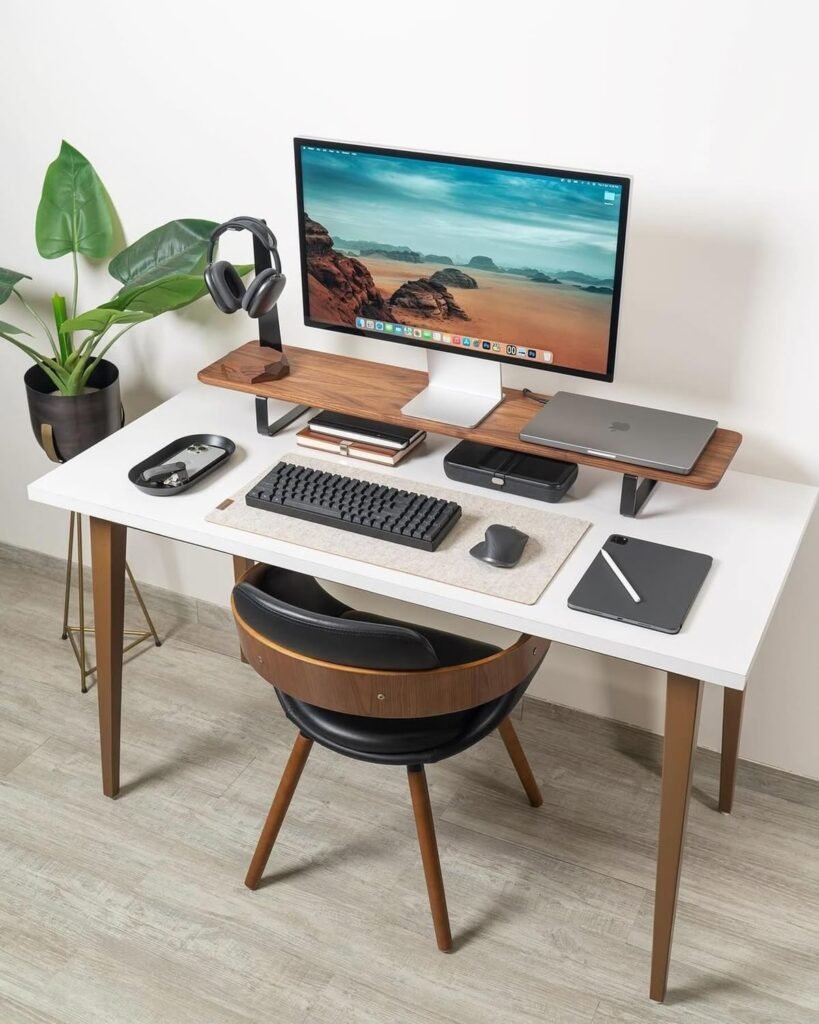
Your workspace speaks to your mind. A cluttered desk says “chaos.” A tidy, purposeful setup says “this is where great work gets done.”
I removed everything from my desk except three items: my laptop, a notebook and a glass of water. That’s it. No phone. No snacks. No random cables.
The result? I stopped reaching for distractions because they were out of reach.
The Remote Desk Life Setup That Works
You don’t need expensive gear. You need a few specific decisions. Here’s what moved the needle most:
| Element | What I Changed | Impact on Focus |
|---|---|---|
| Desk surface | Cleared everything non-essential | Reduced visual noise, fewer urges to fidget |
| Lighting | Added a lamp with warm light | Less eye strain, felt more awake by afternoon |
| Phone placement | Moved it to another room | Biggest single focus boost |
| Notebook | Kept one open for quick brain dumps | Stopped interrupting flow to check notes app |
| Water bottle | Kept a large 750ml bottle on desk | Stayed hydrated, fewer trips to the kitchen |
Dedicate 90 seconds each morning to tidy your desk before work. Think of it as a reset ceremony — it tells your brain that focused time is starting.
3Execute the Night-Before Plan (3 Tasks, Just 3)
Each evening, before shutting down my laptop, I wrote out precisely three things I would accomplish the next day. Not ten. Not a full project list. Three specific, completable tasks.
This changed my mornings completely. Instead of waking up asking “what should I be working on?”, I already knew. I opened my notebook, glanced at the three tasks and started with number one.
Why Three Tasks Works Better Than a Long To-Do List
Long to-do lists create decision paralysis. When you have 20 things to do, your brain cannot figure out where to start. It falls back to easy tasks — clearing emails, rearranging folders — rather than important ones.
Three tasks forces you to prioritize the night before, when you still have clarity. In the morning, you simply perform.
| Planning Style | Tasks Completed Daily (Avg) | End-of-Day Satisfaction |
|---|---|---|
| No plan (reactive) | Random tasks, no clear finish | Low — felt scattered |
| Long daily list (15+) | Some tasks, never finished list | Medium — always felt behind |
| Three-task method | 3 key focus areas completed | High — felt accomplished |
4Block Time in 90-Minute Sprints
No one’s brain works for eight straight hours. That’s not a personal failing — it’s biology. Research on ultradian rhythms indicates that our attention naturally rises and falls in roughly 90-minute cycles.
So rather than resist this, I began to work with it.
How the 90-Minute Sprint System Works
I broke my workday up into 90-minute chunks. In each block, I focused on one task only. Phone face-down. Notifications off. No switching. After 90 minutes, I took a real 15–20 minute break — not a two-minute scroll.
The quality of my output within each sprint improved noticeably. I eliminated the habit of half-working on three things at once.
This method aligns with sleep researcher Nathaniel Kleitman’s findings that the body naturally fluctuates between high-alert and low-energy states roughly every 90 minutes throughout the day.
Sample 90-Minute Sprint Schedule
| Time Block | Activity | Type |
|---|---|---|
| 8:30 – 10:00 | Sprint 1: Deep work (writing, coding, analysis) | High focus |
| 10:00 – 10:20 | Break — walk, stretch, no screens | Recovery |
| 10:20 – 11:50 | Sprint 2: Emails, communication, admin | Medium focus |
| 11:50 – 12:30 | Lunch — full break, step away from desk | Recovery |
| 12:30 – 2:00 | Sprint 3: Second deep work session | High focus |
| 2:00 – 2:20 | Break — light walk or snack | Recovery |
| 2:20 – 3:50 | Sprint 4: Meetings, collaboration, reviews | Mixed focus |
5Kill Notifications During Focus Hours
This sounds obvious. Most people say they’ve tried it. Few people have actually done it.
For the first two weeks, I had Slack, email and my phone on silent — but notifications were still visible on screen. Every badge, every pop-up, every little red dot was siphoning off a tiny bit of my attention.
In week three, I went even further. I disabled all badges, moved my phone into a drawer and used a browser extension to block social media during sprint hours. The difference was dramatic.
The Real Cost of a Notification
According to a University of California, Irvine study, it takes an average of 23 minutes from the time of an interruption to fully return to the original task. One notification doesn’t cost you 10 seconds — it costs you close to half an hour of deep focus.
Try “Notification Hours”: check email and Slack only at 9 AM, 12 PM and 4 PM. Batch your responses. The world doesn’t expect you to respond in real time — and most people won’t even notice the delay.
6Get Your Body Moving Before Opening the Laptop
Not a full gym session. We’re talking 10–20 minutes of movement before work starts.
As part of the experiment, I built a short walk around the block into every morning before sitting down. Sometimes it would be five minutes. Other days, twenty. But it happened before the laptop opened — every time.
Why Movement Changes Your Work Output
Moving your body increases blood flow to the prefrontal cortex — the area of your brain that handles planning, focus and decision-making. Starting your day with movement primes that part of the brain when you most need it.
I noticed that my mornings began with greater mental clarity. Ideas came faster. Writing felt smoother. The creative drag that normally hit me midmorning started to shift or disappear entirely.
| Morning Routine | Mental Clarity (1–10) | First-Hour Performance |
|---|---|---|
| Wake up → laptop immediately | 4–5 | Slow, unfocused first 45 min |
| Coffee + scroll → laptop | 6 | Mildly better but reactive mode |
| Walk → water → laptop | 8 | Flow hit within 10 min |
7Have a “Shutdown Ritual” to End Your Workday
If there is one thing that remote desk life challenges most, it’s knowing when to quit. Without a commute, work seeps into evenings. You’re “just checking one more thing” at 8 PM and suddenly your brain never shuts off.
I created a five-minute shutdown ritual. There were four things I did in the same order at a specific time every day:
- Reviewed what I accomplished (checked off tasks)
- Wrote out tomorrow’s three tasks
- Closed all browser tabs and apps
- Said out loud: “Work is done for today.”
That last part sounds strange. But it works. Saying it aloud creates a cognitive break — a signal that work mode is now officially off.
Cal Newport, author of Deep Work, refers to this as a “shutdown complete” ritual. The point is to send your brain a clear signal that it’s safe to disengage — so you can truly rest and recover.
8Talk to at Least One Person Every Day
Remote work can get lonely fast. And loneliness doesn’t just damage your mood — it also destroys your focus, creativity and motivation.
During the experiment, I committed to having at least one real conversation every single day. Not a Slack thread. A real voice or video call — or even a walk with a neighbor. It didn’t have to be work-related.
The Isolation Trap in Remote Desk Life
When you’re working solo day after day, small setbacks feel larger. Decisions get harder. Creative thinking slows down. Human connection resets all of that.
I found that on the days I had a good conversation — even a 15-minute check-in with a colleague — the afternoon sprint felt easier. My mood was better. My output was higher.
Set up a weekly “virtual coffee” with a teammate or friend. Protect it on your calendar like any other meeting. Social connection is not a luxury in remote work — it’s maintenance.
9Do a Weekly Review Every Friday Afternoon
The final — and perhaps most underrated — habit is the weekly review. At 3 PM every Friday, I blocked 30 minutes to look back at the week.
I asked myself four simple questions:
- What went well this week?
- What got in the way?
- What is one thing I will do differently next week?
- What one thing must I finish by Friday next week?
How the Weekly Review Builds Up Over Time
Each review takes 30 minutes. But the value accumulates over weeks. You start to notice patterns — when you’re most focused, tasks that never seem to get done, distractions that keep showing up.
After four weekly reviews, I had an accurate picture of exactly what my best and worst productivity habits were. That self-awareness is difficult to obtain any other way.
| Habit | Time Investment | When to Do It | Biggest Benefit |
|---|---|---|---|
| Hard start time | 0 extra minutes | Every morning | Eliminates morning drift |
| Desk reset | 90 seconds | Before work starts | Signals focus time to brain |
| Night-before plan | 5 minutes | Before shutting down | Removes morning decisions |
| 90-minute sprints | 0 extra | All day | Matches natural energy cycles |
| Notification blocking | 2 minutes to set up | During sprint hours | Protects deep focus |
| Morning movement | 10–20 minutes | Before laptop opens | Boosts mental clarity |
| Shutdown ritual | 5 minutes | End of workday | Separates work from rest |
| Daily human contact | 15–20 minutes | Any time of day | Prevents isolation drift |
| Weekly review | 30 minutes | Friday afternoon | Builds long-term self-awareness |

What to Do First Without Feeling Overwhelmed
Don’t try all nine at once. That’s a recipe for burning out on habits before they can take hold.
Instead, choose two of these habits that feel most relevant to what you’re struggling with right now. Run them for one week. Add one more the week after. Build slowly — and build for the long haul.
The best remote desk life productivity system is one you will actually follow when tomorrow morning rolls around. Start there.
Frequently Asked Questions
How long does it take for remote work productivity habits to kick in?
Most habits take about 7–14 days to form noticeably. Habits such as the hard start time and notification blocking can make a difference within the first two or three days. Deeper habits like the weekly review need a few weeks before the compound benefit becomes clear.
What is the most effective remote desk life habit for beginners?
The night-before three-task plan. It’s low-effort (five minutes), requires no gear and removes the biggest morning time-waster: deciding what to work on. It’s the best habit to start with.
Do I need a separate home office to work from home efficiently?
No. A dedicated room certainly helps, but it’s not a must. More important is having a consistent spot you use only for work — even if it’s just one end of a kitchen table. It’s the spatial association that cues your brain, not the square footage.
How can I avoid working late as a remote worker?
The shutdown ritual (Habit 7) is specifically designed for this. Establish a hard stop time, go through your four-step ritual and physically close or put away your laptop. Without a commute to force the transition, you have to create it yourself.
Is the 90-minute sprint method workable for jobs with lots of meetings?
Yes, with adjustment. Schedule your sprint blocks to fit around your meeting schedule rather than against it. Protect at least one 90-minute sprint in the morning before meetings begin. Even a single protected deep work block every day is far better than none.
Can these habits work for part-time remote workers too?
Absolutely. In fact, part-time remote workers often benefit even more as they have to switch quickly between office and home contexts. A steady routine on home days makes sure that context-switching cost doesn’t eat into productive time.
The Bottom Line
Remote desk life productivity isn’t about hustle. It’s about crafting your day so that good work emerges naturally — without needing to force it every single morning.
The nine habits in this article aren’t complicated. They don’t require fancy equipment or drastic lifestyle changes. They require consistency and the intention to treat your home workspace as you would a professional office.
Begin with two habits this week. Watch what changes. Add one more the week after. In 30 days, you will have your own data — and your own proof that remote work can be the most productive setup you’ve ever had.
The desk is ready. The habits are here. All that’s left to do is begin.