Meta Description: Remote desk life productivity tools can transform your work-from-home routine. Explore 10 apps for daily use that increase focus, organization, and output — beginning today.
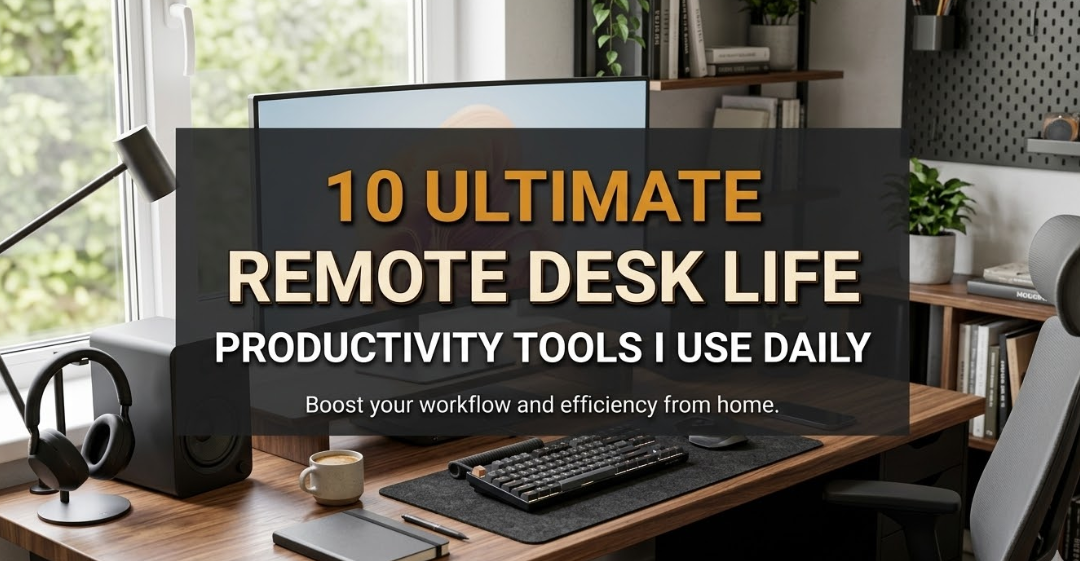
10 Ultimate Remote Desk Life Productivity Tools I Use Daily
Working from home seems like a dream — no commute, no dress code, coffee brewed in your kitchen. But anyone who has lived the remote desk life knows the deal: it’s hard to be productive. Distractions are everywhere. Meetings blur into emails. Tasks pile up before lunch.
I’ve been working remotely for years. And I’ve experimented with dozens of tools over time. Some were useless. Some changed everything. This article is about the 10 tools I actually open every single day — the ones that make remote work less chaotic and more of a system.
The best apps for working from home have you covered on all sides of the remote desk life productivity puzzle, and they’re applicable whether you’re new to quiet-office life or a longtime remote worker looking for an upgrade.
Why Remote Workers Have It Harder Getting Things Done
Before we dive into tools, let’s come clean about the problem.
The office provided structure we took for granted. A start time. A physical space that represented “work mode.” Colleagues who kept us accountable.
At home, that structure disappears. And even people who are motivated drift in the absence of it. You sit down at 9am. By 10am, you’ve logged onto Instagram, put in a washload and — what? — have totally forgotten what you were about to do.
That’s not a willpower problem. It’s a systems problem.
The right tools establish the framework your remote workspace lacks. Let’s see which ones do so best.
Tool #1 — Notion: Your Desk-Side Second Brain
Notion is the one app I couldn’t live without.
Notion is a digital workspace for writing notes, building databases, planning projects and storing anything else you might otherwise forget. It’s a notebook, a wiki, a task board, and a personal knowledge base — all in one.
Why It Works for Remote Employees
In an office, you can just tap your colleague for a quick question. At home, you’re on your own. Notion makes it easy to create a personal library of information, so you’re not starting with a blank slate.
I use Notion for:
- Daily stand-up notes
- Project wikis
- Reading lists and article saves
- Meeting summaries
The free plan is generous. Paid plans also unlock collaboration features that are ideal for small remote teams.
Best feature: Linked databases. You can link a task list to a project page, and to a calendar view — all syncing in real time.
Tool #2 — Todoist: Tasks Completed in Practice
A to-do list sounds basic. But Todoist makes your task list a priority engine.
What makes Todoist different from a sticky note is its natural language input. Just type “submit report every Friday at 4pm” and Todoist generates a recurring task. No menus, no clicking around.
Making Your Workday Feel Manageable
There’s so much to do when you work behind a remote desk. A single email thread can generate five action items. Todoist collects all of those in a single clean inbox.
I have a simple rule: each morning, I check my Todoist inbox and move things into today, this week, or someday. That three-minute ritual prevents my day from becoming chaotic.
Key features to use:
- Priority levels (P1 through P4)
- Recurring task scheduling
- Integrations with Gmail, Slack and calendars
Tool #3 — Slack: The Open Office Chatter Replacement
Slack is the home for your remote team. It takes the place of hallway conversation, quick desk pop-in and group email chain — all at once.
But here’s what most remote workers do wrong: they use Slack like email. They leave notifications on throughout the day and respond to every message as soon as it arrives.
Make Slack Work for You, Not Against You
The trick is: treat Slack like a tool, not a chain.
Every morning I define “Do Not Disturb” hours. I only check Slack in batches — at 10am, 1pm and 4pm. This one move doubled how much deep work I produce in a day.
Tip for life on the remote desk: Make your own #today channel just for you. Every morning write down your three goals for the day. It creates visible accountability.
Top Slack features for remote work:
| Feature | What it does |
|---|---|
| Huddles | Quick voice/video calls without needing to schedule a meeting |
| Workflow Builder | Automates routine check-in or standup questions |
| Do Not Disturb | Blocks notifications during focus hours |
| Threads | Keeps conversations organized without cluttering channels |
Tool #4 — Loom: Never Book a Meeting You Don’t Have To
Loom is a screen and camera recorder. You click record, explain whatever you need to explain and share a link. The other person views it when they feel like it.
This sounds simple. But it’s really one of the most impactful changes you can make in remote work.
Why Async Video Changes Everything
Consider how many meetings you have been in that would do just as well being a 2-minute video. Loom eliminates most of those.
I use Loom when:
- Giving feedback on a design or document
- Guiding a client through a deliverable
- Explaining a bug to a developer without having to make a call
The receiver can view at 1.5x speed, skip ahead and leave time-stamped comments. It’s quicker than a meeting and more humane than a wall of text.
Free plan includes: Unlimited recordings up to 5 minutes. That should suffice for most use cases.
Tool #5 — Toggl Track: Know Where Your Time Is Actually Going
Time blindness is one of the biggest remote desk life productivity killers. You believe you spent 30 minutes on email. Your Toggl report shows 2 hours.
Toggl Track helps you track time easily with just one click. You start a timer when you enter a task, stop it when you complete it, and receive a weekly report that confirms precisely how your hours were spent.
What the Data Will Teach You
After two weeks of tracking, most remote workers are surprised by what they discover. In an 8-hour day, the time available for deep work (actual productive output) is often less than 3 hours.
The rest? Emails, context switching, Slack, and little tasks that made you feel productive but weren’t.
How I use Toggl:
- Every new task should be tagged with a project name
- Every Friday, read the weekly report
- Circle your two largest time leaks and remedy one weekly
Tool #6 — Clockwise: Use AI to Optimize Your Calendar
The vast majority of remote workers manage their calendar in a reactive way. The meetings land and you work around them.
Clockwise flips that model. It uses AI and automatically reschedules your meetings to preserve blocks of uninterrupted focus time.
Why Your Calendar Is Sabotaging You
Back-to-back meetings destroy deep work. When you have a call at 10am and another at 11:30am, that 90-minute gap is nowhere near long enough to get into a real flow state. You end up with quasi-tasks, and wait.
Clockwise detects the natural clusters of meetings on your calendar and gently pushes them together. That allots bigger, uninterrupted blocks of time for real work.
The Focus Time feature designates specific time blocks as protected on your calendar. Teammates see you as busy. You get the uninterrupted time your thinking brain needs.
Tool #7 — Krisp: Mute the World Around You
Working from home means unexpected noise. Dogs barking. Neighbours drilling. Kids in the hallway.
Krisp is a noise-cancellation app that removes all background sound from your microphone — in real time. On any call, on any platform, your voice is as clear as if you’re in a professional recording studio.
What It Actually Does
Krisp lives between your microphone and your video call app. It uses AI to determine which audio is your voice and which is background noise. Then it strips the noise entirely before it ever hits the call.
It also drowns out noise on the other end. If your colleague is calling from a loud café, you can enable Krisp to clean up their audio on your end too.
Works with: Zoom, Google Meet, Microsoft Teams, Slack, Discord and more.
Free plan includes: 60 minutes per week of noise cancellation — plenty to try out before paying.
Tool #8 — 1Password: Stop Wasting Time on Passwords
This one doesn’t sound exciting. Yet time spent dealing with passwords adds up more than you realize.
Password reset emails. Trying three variations of the same password. Searching for login information in a notes app. Remote workers have more logins than office workers because each collaboration tool requires a separate account.
The Real Productivity Case for a Password Manager
1Password stores every login securely and fills them in with one click. But it does more than that.
For remote teams, the 1Password Teams plan allows you to securely share credentials without ever typing a password in Slack or email. It also identifies weak or reused passwords and encourages you to address them.
According to NordPass’s annual research, the most common passwords are still embarrassingly easy to crack — a password manager removes that risk entirely.
Remote desk life bonus: 1Password has a travel mode that hides sensitive vaults when working from a café or co-working space.
Tool #9 — Figma: Collaborate Without Sending Files
Figma has to be on this list, even if you are not a designer.
Figma is a browser-based design and collaboration tool. You can build wireframes, annotate screenshots, create presentation slides, or even use it as a visual whiteboard for remote brainstorming.
Why Non-Designers Use Figma Daily
Prior to Figma, giving feedback on a design involved writing an extensive email or pointing at things during a screen share. Now you simply open the Figma file, click on an element and leave a comment directly on top of whatever you’re commenting about.
The killer feature for remote desk life productivity is real-time collaboration. You can watch your colleague’s cursor move through the file. You’re both looking at the same version. No “final_final_v3.pdf” getting sent around.
Best use cases for non-designers:
- Commenting on website mockups
- Running remote whiteboard sessions
- Building simple slide decks
- Mapping user flows and processes
Tool #10 — Forest: Grow a Tree, Stay Off Your Phone
The biggest enemy of productivity in a remote work environment is not poor tools. It’s your phone.
Forest is a focus app that turns phone avoidance into a game. You plant a virtual tree and set a timer — 25 to 90 minutes. If you leave the app to check social media, your tree dies. Stay on track, and your tree grows.
Why Gamification Works for Focus
It sounds silly. But the mere desire not to kill a virtual tree is enough to keep most people off their phones for a session. As your sessions are completed, they build a virtual forest. That visual reminder of your focused work becomes truly motivating.
Forest also plants real trees in the world with money from premium subscriptions. So you’re literally helping with reforestation by staying focused.
Best for: Anyone who knows their phone is a problem but hasn’t quite managed to put it down.
How These 10 Tools Work in Unison
These tools aren’t random. They span every layer of the remote desk life productivity stack.
Here’s how a typical day flows using all 10:
Morning (8:30am)
- Open Notion for your daily note and summaries from yesterday’s meetings
- Check Todoist and choose your top 3 priorities
- Review Clockwise — your calendar has been optimized overnight
Morning deep work block (9am–12pm)
- Forest timer running
- Toggl tracking your first project
- Krisp turned on for your 11am check-in call
- Slack on Do Not Disturb
Midday (12pm–1pm)
- Check Slack messages in batch
- Replace a meeting request with a Loom
- Use 1Password to log in when trying out new platforms
Afternoon (1pm–5pm)
- Figma open for collaborative review session
- Todoist updated as tasks complete
- Toggl captures all afternoon work
By the end of the day, you get a full view of what you spent your time on, tasks are recorded and your team is aligned — without constant disruption.
Quick Comparison: All 10 Tools at a Glance
| Tool | Best For | Free Plan? | Paid From |
|---|---|---|---|
| Notion | Notes, wikis, databases | Yes | $10/mo |
| Todoist | Task management | Yes | $4/mo |
| Slack | Team messaging | Yes | $7.25/mo |
| Loom | Async video messages | Yes (5 min limit) | $12.50/mo |
| Toggl Track | Time tracking | Yes | $9/mo |
| Clockwise | Calendar AI & focus time | Yes | $6.75/mo |
| Krisp | Noise cancellation | Yes (60 min/wk) | $8/mo |
| 1Password | Password management | No (trial) | $2.99/mo |
| Figma | Design & visual collab | Yes | $12/mo |
| Forest | Phone focus timer | Yes | $3.99 one-time |
3 Tools to Start With If You’re New to This
If this list seems overwhelming, do not try to adopt all 10 at once.
Start with these three. They fill in the most critical gaps and are all free to start:
- Notion — Get your notes and tasks out of your head and into a system.
- Toggl Track — Track every task for one week. The data will tell you exactly what to fix.
- Krisp — If you’re on calls from home, this is a no-brainer from day one.
Add the rest one at a time once those feel natural.
The Remote Desk Life Mindset Behind These Tools
No tool works in isolation. These 10 fit together because they each address a unique category of friction in the remote desk life.
Clarity — Notion and Todoist ensure you always know what you’re supposed to be working on.
Focus — Forest and Clockwise shield your time from distractions.
Communication — Slack and Loom keep your team connected without redundant meetings.
Measurement — Toggl shows you where your time is actually going.
Environment — Krisp takes care of the audio environment you can’t always control at home.
Infrastructure — 1Password and Figma reduce daily friction, taking care of login management and file version chaos.
When all six of those categories are covered, the remote desk life stops feeling scattered. It starts to feel like a real, functional workspace.
FAQs About Remote Desk Life Productivity Tools
Q: Do I need to pay for all of these tools?
No. All of the tools mentioned in this article offer free plans for the majority of day-to-day use cases. You can build a very robust remote work setup for $0, and then upgrade individual tools as your needs grow.
Q: Are these tools suitable for freelancers or just for team-based remote workers?
Every one of the 10 is suitable for solo freelancers. Notion, Todoist, Toggl, Forest and Clockwise are invaluable for independent workers who don’t have a team structure around them.
Q: How do I avoid productivity tool overload? Sometimes having too many apps makes things worse.
One tool per category is a good place to start. You need one task manager, one note-taking app and one focus tool. That’s three apps. Everything else can come later. The objective is to minimize friction, not give yourself more software to manage.
Q: Is it safe to store all my passwords in 1Password?
Yes. 1Password uses end-to-end encryption. Your master password is never sent to their servers. In the event of a breach, your data would remain unreadable. It is far more secure than recycling passwords or saving them in notes or spreadsheets.
Q: Can these tools support work-life balance, not only productivity?
Absolutely. Clockwise protects your calendar. Forest keeps your evenings phone-free. Toggl warns you if you’re putting in too many hours. Slack’s Do Not Disturb stops after-hours pings. Together they help you switch off, not just work harder.
Q: What if my team uses different tools?
Most of these tools integrate with each other and with alternatives. Toggl works regardless of what your team uses. Notion can import data from other apps. Krisp is compatible with all video platforms. You don’t even need your whole team to switch — most of these improve your individual experience regardless.
Q: Is Forest actually effective for adults, or is it just for students?
Forest is used by professionals, students and creatives alike. The gamification element works differently for different people, but the core mechanic — set a focused timer and put your phone away — is effective at any age. Remote workers often pair it with the Pomodoro Technique for structured work sprints.
In Closing: Build Your Remote Desk Life System
The remote desk life is tomorrow’s working reality. But it only works well when you have the right system built around it.
These 10 tools aren’t magic. They will not, by themselves, make you more focused or organized. But when you use them together with intention — using the right tool for the right job at the right moment — they form a structure that feels almost as supportive as a well-run office.
The trick is to start small, remain consistent and pay attention to what’s really holding you back. Your data (especially from Toggl and Clockwise) will tell you where to focus next.
Pick one tool from this list today. Set it up properly. Use it for two weeks. Then add the next one.
That’s how the remote desk life goes from overwhelming to outstanding.